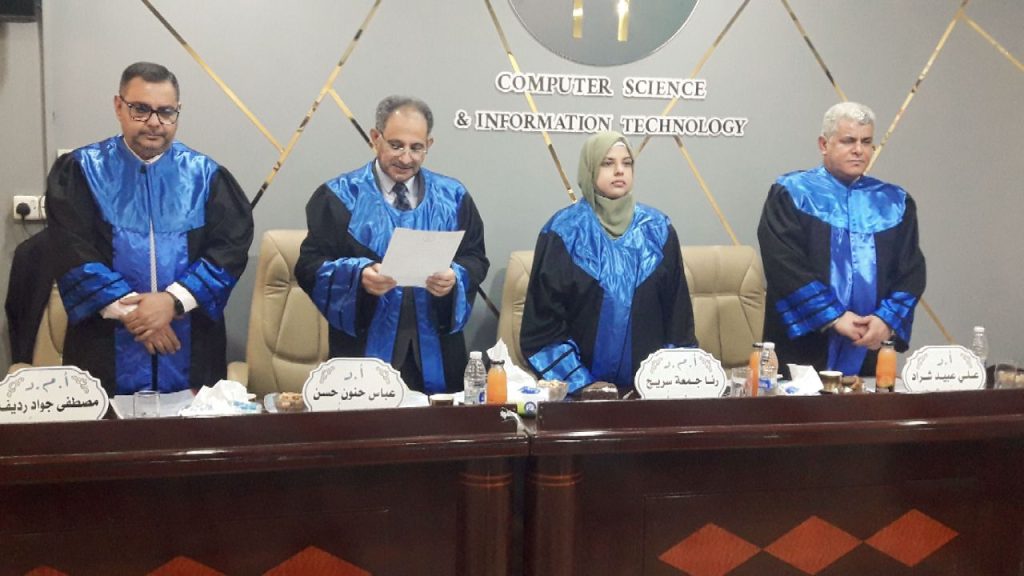
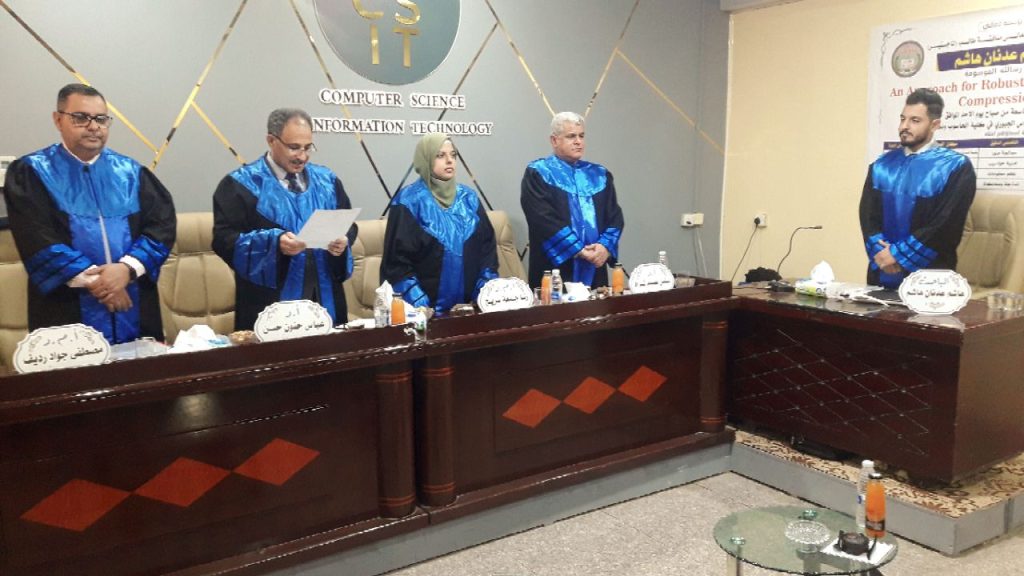
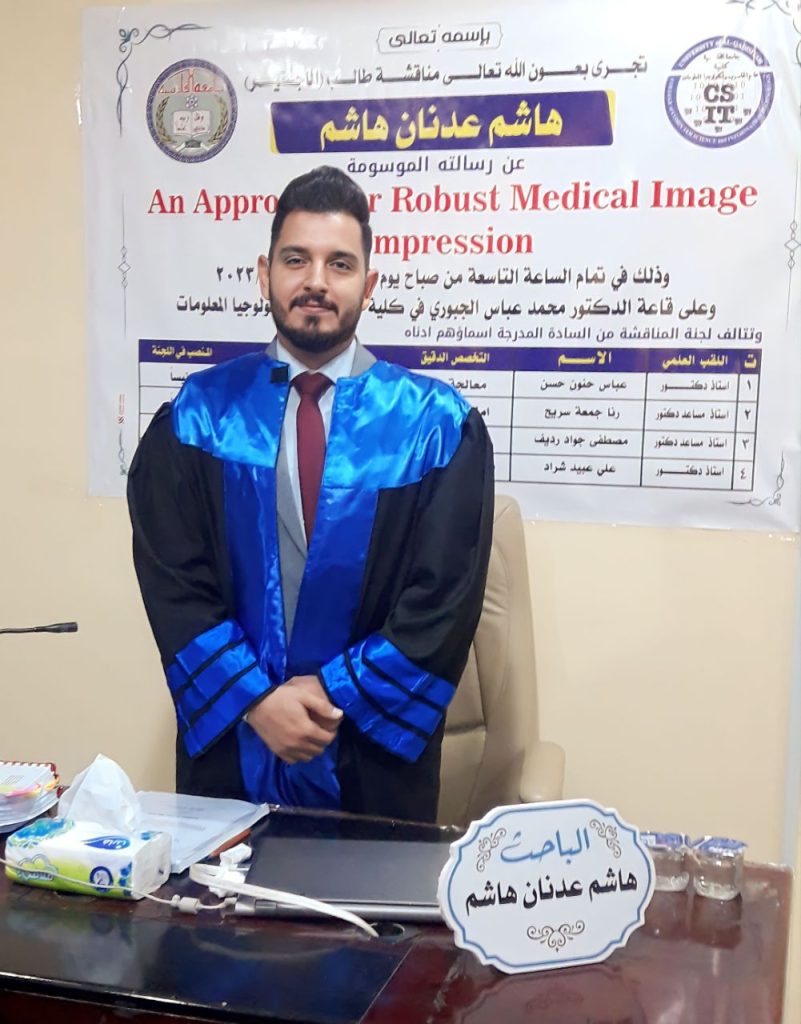
The master’s student, Hashem Adnan Hashem, conducted this research under the supervision of Professor Dr. Ali Obeid Sharad.
The study aims to reduce data redundancy in medical images for efficient storage and transmission. Current compression algorithms often sacrifice image quality for compression, making the compressed medical images less useful due to reduced clarity. To address this challenge, this thesis proposes a unique hybrid approach that relies on the SPIHT algorithm for medical image compression. It employs a simple and effective mechanism utilizing Discrete Wavelet Transform (DWT) while maintaining a high structural similarity (MSS) and a peak signal-to-noise ratio (PSNR).
The proposed method comprises three stages: pre-processing, wavelet transformation, and SPIHT algorithm. Median and Gaussian filters are applied in the pre-processing step to significantly reduce artifacts and noise in medical images. In the second stage, the impact of using multiple DWT levels is explored through testing two and three DWT levels. In the third and final stage, the SPIHT algorithm is applied to all sub-band coefficients of DWT, employing Huffman encoding for output coding. The experimental work is conducted using the MATLAB platform with a dataset consisting of medical images.
The results demonstrate that the proposed hybrid model of DWT and SPIHT is the preferred choice for medical image compression. The study’s results outperform nearly all previous publications, with a Compression Ratio (CR) of 17.9492, PSNR of 43.4377, and Mean Squared Error (MSE) of 2.9465.
The thesis was accepted with Excellent .